



Fighting Terrorism in India — Article in which Maj. Gen. Kulwant Singh and Dr. David Leffler advocate that India’s military should adopt Invincible Defense Technology to permanently stop terrorism and war. Published by Indian Armed Forces.
Combattere il terrorismo in India
This article appeared in Portale Italiano Meditazione Trascendentale. It is an Italian translation of “Fighting Terrorism in India.” English version.

Combattere il terrorismo in India
Il terrorismo è un problema affatto facile da risolvere. L’India ha combattuto il terrorismo per più 50 anni. Fin dall’indipendenza nel 1947, gli stati orientali sono sotto pericolo di insurrezione fomentata dagli stati esteri. La tanto contesa regione del Kashmir è una polveriera che minaccia di esplodere in una guerra convenzionale e in una possibile guerra nucleare ogni giorno. Una soluzione praticabile potrebbe risiedere nell’antica conoscenza vedica che è stata scientificamente comprovata nel XX secolo. Ora, nel XI secolo, l’antico metodo indiano di difesa preventiva, denominata “invincibile” promette la fine del terrorismo e dei conflitti e offre un modello per tutto il resto del mondo. L’India è pronta a rinverdire il suo illustre passato?
L’India ha combattuto quattro grandi guerre a causa della contesa del Kashmir occidentale. Il Pakistan ha poche probabilità di vincere una guerra convenzionale contro l’India. Per questo motivo, il Pakistan è dichiaratamente ricorso all’invio di terroristi nel Kashmir chiamandoli combattenti per la libertà”. Questa è una verità universale: da una parte si è terroristi dall’altra combattenti per la libertà.
A livello globale l’impatto del terrorismo si è accresciuto fin da quando Al-Quaeda ha formato delle alleanze con le preesistenti organizzazioni terroristiche. L’aumento della tensione e lo spettro di una guerra nucleare tra India e Pakistan ha scatenato un esodo di massa di cittadini stranieri tanto dall’India quanto dal Pakistan.
Così come molti altri paesi, l’India ha combattuto il terrorismo attraverso un approccio dinamico, per esempio con armamenti e personale militare. Malgrado la sua lunga esperienza nella lotta contro il terrorismo, l’India sta ancora perdendo questa guerra. Il terrorismo sta crescendo nei numeri. Aggiungendosi alla lotta dei terroristi stranieri, emergono nuove organizzazioni, come i Peoples War Group (PWG). Il numero di tali organizzazioni e squadriglie che si sono uniti a loro è allarmante. Anche con polizia ben equipaggiata e forze paramilitari l’India non è in grado di controllarli completamente. Ancor più allarmante, gli esperti di difesa predicono che è solo questione di tempo prima che i terroristi attacchino con armi di distruzione di massa maneggievoli, facili da trasportare e nascondere.
La tensione tra India e Pakistan cresce e decresce e, di frequente, entrambi sono sul piede di guerra. Se sarà, la strategia dell’India, come annunciato da tempo, sarà per una “offensiva limitata” volta a fermare il terrorismo. La stessa denominazione “offensiva limitata” è ingannevole perchè non è quantificabile.
Implica sforzi limitati nelle forze, nell’area dell’offensiva, nell’uso di sistemi d’attacco e così via? In ogni caso, i leader dell’India potrebbero volerla limitata, ma non può essere ammesso di fronte agli avversari. Con tutta probabilità, una volta scoppiata la guerra, questa non sarà limitata.
Può dunque l’India eliminare il terrorismo sviluppando la forza militare così come ha fatto negli ultimi 50 anni? La storia ci ha continuamente dimostrato che la rispsta è “no”. Il terrorismo è un problema umano, e quindi necessita di una soluzione umana. La causa misconosciuta del terrorismo, della guerra, dei conflitti così come di altre forme di violenza sociale, è lo stress della società.
Se lo stress collettivo che crea il terrorismo puo essere prevenuto, problemi così negativi potranno cessare. Così niente stress collettivo, niente terrorismo, e niente guerra.
Un approccio silenzioso a questo prevenzione ideale è descritta nella letteratura vedica. “Heyam duhkham anagatam” (Yoga Sutra, 2.16): “Evita il pericolo prima che insorga”. Lo Yoga Sutra 2.35 afferma anche “Tat sannidhau vairatyagah” cioè “In vicinanza di un’influenza yogica – un’influenza unificatrice, integrante, coerente e armoniosa – le tendenze conflittuali non si manifestano”. Queste antichi principi erano applicabili in passato, e possono esserlo nel presente.
Secondo la tradizione vedica, i conflitti nascono dall’ignoranza, l’ignoranza sul come prevenire l’aumento dello stress collettivo. Per esempio, il Ramayana afferma che:”…l’ignoranza non ha accesso entro otto miglia (dal luogo dell’eremitaggio dello Yogi)”. Il Ramayana descrive inoltre la antica città di Ayodhya. “Ayodhya” significa “la città che nessuno può sfidare in guerra”. Sicuramente, Ayodhya si fondava sulle tecnologie di difesa convenzionale del suo tempo. Per esempio, era circondata da possenti fortificazioni e da un profondo fossato, “che nessun nemico, qualsiasi espediente escogitasse, non avrebbe potuto penetrare”. Inoltre, “Ayodhya abbondava in guerrieri mai vinti in battaglia, senza paura ed esperti nell’uso delle armi, simili a leoni che difendono le loro grotte di montagna”. Comunque, la descrizione della vita illuminata e senza stress degli abitanti di Ayodhya indica che la sua prima linea di difesa fosse la libertà della città dallo stress collettivo. In accordo con il Ramayana, questo livello basso di stress, fondato su una vita in armonia con la Legge Naturale, rese Ayodhya degna della sua fama.
Questo ideale di difesa preventiva può essere realizzato nuovamente in India?
Lo studioso vedico e fisico Maharishi Mahesh Yogi ha ravvivato le componeti pratiche dell’approccio silenzioso della tecnologia di difesa invincibile che chiama Meditazione Trascendentale (MT) e programma delle MT-Sidhi. Queste tecnologie che si basano su risorse umane non richiedono ne implicano un credo e pratiche religiose. Queste tecniche di meditazione sono praticate da membri di molte fedi di tutto il mondo. Un gran numero di ricerche scientifiche documentano la capacità della MT e del programma delle MT-Sidhi di dissolvere lo stress a livello individuale e collettivo. L’India potrebbe usare questa costruttiva tecnologia di difesa invincibile per ridurre le tensioni e quindi prevenire le tendenze conflittuali che alimentano il terrorismo.
La componente operativa della Tecnologia di Difesa Invincibile necessita di un Corpo di Prevenzione nell’esercito. Questo corpo comprenderebbe circa il 2-3% delle forze armate. La restante parte delle truppe continuerebbero a sbrigare i loro usuali compiti.Il Corpo di Prevenzione dell’esercito creerebbe coerenza nella società grazie alla pratica della MT e del programma delle MT-Sidhi. in grandi gruppi, la mattia e la sera. La loro pratica collettiva produrrebbe effetti positivi sia per se stessi che per i loro nemici. Le tendenze alla pace aumenterebbero da entrambe le parti.
Simili gruppi di coerenza sono già stati dislocati in molte zone di guerra ed aree di conflitto con grande successo. Numerose ricerche scientifiche indicano che quando l’1% della popolazione pratica la MT, o la radice quadrata dell’1% della popolazione pratica il più avanzato programma di MT-Sidhi in gruppo si crea “l’effetto campo”. Questo effetto è stato dagli scienziati chiamato “l’Effetto Maharishi”. Oltre 50 studi accurati e controllati hanno documentato e convalidato le tendenze sociali positive quali la riduzione dei conflitti e il diminuito tasso di criminalità. Questi studi sono stati esaminati e pubblicati su rinomati giornali quali il Social Indicators Research, il Journal of Conflict Resolution, il Journal of Mind and Behavior e il Journal of Crime and Justice.
Questo effeto creatore di coscienza è stato anche documentato su scala globale. Quando grandi assemblee di praticanti il programma delle MT-Sidhi superarono la soglia per il mondo dell’Effetto Maharishi (circa 7000 a quel tempo) negli anni 1983-1985, i conflitti internazionali decrebbero del 33%, gli incidenti terroristici del 72% e la violenza si ridusse in altre nazioni senza l’intrusione di governi stranieri.
Quindi, la costituzione di un Corpo di Prevenzione dell’esercito da parte dell’India potrà essere un moltiplicatore di forza. Rafforza entrambi gli approcci di difesa, quello dinamico degli armamenti e del personale militare e quello silenzioso basato sulla Tecnologia della Difesa Invincibile. La difesa dell’India sarà perfetta, o invincibile, quando entrambi questi approcci saranno combinati.
L’India non può risolvere il problema del terrorismo attraverso i soli mezzi militari tradizionali. Necessita anche di un approccio silenzioso, che aiuterà la gente più a focalizzarsi sui mezzi di pace che conciliare le differenze. L’eredità vedica dell’India offre i mezzi ideali per combattere il terrorismo e prevenire la guerra. L’India ha bisogno di costituire un Corpo di Prevenzione dell’esercito immediatamente per una pace duratura.
Gli articoli sulla Tecnologia della Difesa Invincibile, pubblicati su Defence India, Defense Review, Indian Armed Forces, India Defence Consultants, Indian Defence Review, Indian Strategic Review et Security And Political Risk Analysis (SAPRA) Bulletin, sono disponibili su Internet all’indirizzo: www.davidleffler.com
Il Gen. Magg. (Dott.) Kulwant Singh, UYSM, Retd. ha ricevuto il suo Ph.D. e il suo M.SC. in studi di difesa presso la Chennay University. Ha conseguito inoltre un diploma specialistico in Sviluppo delle Risorse Umane presso la Indira Gandhi National Open University (IGNOU) a New Delhi. Il dott. Singh ha inoltre un diploma specialistico in Management conseguito presso il Regional College of Management and Technology (RCMT). E’ abilitato per il prestigioso Higher Command Course nel College of Combat ed è un graduato del Defence Service Staff College. Ha combattuto e comandato la lotta contro il terrorismo fondamentalista indiano per quasi trent’anni. Il Gen. Magg. Singh ha guadagnato la Uttam Yudh Sewa medal, la seconda decorazione in ordine di importanza per gli ufficiali più anziani durante le operazioni in Sri Lanka assieme alle IPKF (Indian Peace Keeping Force). Attualmente sta dirigendo un gruppo internazionale di generali ed esperti di difesa che promuovono la Tecnologia della Difesa Invincibile. Il Dott. Singh vive a New Delhi, India. Email: Kulwant Singh
Il dott. David Leffler ha conseguito il suo Ph.D. sula Tecnologia della Difesa Invincibile presso l’Union Institute and University. Gli altri titoli accademici includono un B. A. in Educatio, un M. A. in Scienza dell’Intelligenza creativa presso la Maharishi University of management e un M. M. in Educazione presso la New Mexico State University. E’ stato membro delle U.S. Air Force per otto anni. Il dott. Leffler è un membro fondatore del Center for Advanced Military Science (CAMS) della Maharishi University Of Management. Lavora inoltre come Peer Member presso The Union Institute ed è membro dell’ U.S. Naval Institute. Il dott. Leffler ha presentato la Tecnologia della difesa Invincibile all’ Accademia Aereonautica Russa, l’Accademia delle Scienze Russa, e le istituzioni relative alla difesa degli Stati Uniti. Il Dott. Leffler vive a Wassingers Falls, New York, USA. Email: drleffler [@] hotmail[dot]com.
Pubblicazioni in Inglese
Israni, Major General G.H. & Leffler, D. R. (2002, June 24). “Operation: World Peace” Defence India.
Leffler, D.R., & Leffler, L.M. (2002, January 11). “How to End Terrorism & War: About a Consciousness-Based Defence System.” About.com.
Leffler, D. R. (2002, January 06). “Supreme Military Might.” India Defence Cosultants.
Quantifying the field effects of consciousness – paper by David W. Orme-Johnson, Ph.D.
Quantifying the field effects of consciousness:
From increased EEG coherence to reduced international terrorism
Published in: Proceedings: Bridging Worlds and Filling Gaps in the Science of Healing.
Corona del Mar, CA: Samueli Institute for Informational Biology, 2002:326-346. (R.A. Chez, editor)
Today I will reviews the methodology and results of a few key studies from a body of 50 studies demonstrating field effects of consciousness through the Transcendental Meditation technique (TM). These studies have found reduced crime rate and decreased crime rate trend in cities after 1% of their population learned the TM technique, controlling for demographic correlates of crime. Causal analyses of random samples of 160 US cities and 40 Standard Metropolitan Statistical Areas over a seven-year period found stable causal structures in which the percent of the population practicing the TM technique predicted reduced crime in subsequent years. The greater the number of meditators in a city, the greater the reduction of crime in the cities in subsequent years, controlling for 13 crime-correlated demographics.
Other studies have shown that groups of the TM and TM-Sidhi program including Yogic Flying (the TM-Sidhi program is an advanced variant of Transcendental Meditation) that groups of the square root of 1% of the world population (approximately 7,000 in the mid 1980’s) predicted decreased international conflicts and terrorism on a global scale, using data bases from independent scholars who are in no way connected with this research program. The paper concludes that there is strong cross-validating evidence from a wide variety of sources that the TM and TM-Sidhi program is an effective technology for reducing and preventing international conflicts and terrorism.
A physiological study suggested that during Yogic Flying by a group of 2,500, EEG coherence increased between three individuals at a distance of over 1,000 miles away. Increased EEG coherence in a single Yogic Flier predicted increased EEG coherence in a non-meditator in the next room. The size of a group practicing the TM and TM-Sidhi techniques predicted changes in the stress hormone cortisol and in 5-HIAA, the main metabolite of serotonin in non-meditators working within a 20-mile radius of the group.
When we started our research on field effects of consciousness 27 years ago, the biggest barrier was conceptual—how could we understand people interacting with each other at a distance? Of all the research on meditation, this posed the biggest threat to most scientists’ world-view. Today there is a wide range of converging evidence for the phenomenon, much of it by people at this conference. But it still remains a threat to many, and with good reason. None of the four basic physical fields—electromagnetism, weak interaction, strong interaction, or the gravitational field— seem plausible candidates for mediating the effect. The electromagnetic field generated by the nervous system is many orders of magnitude too small to plausibly explain how people on opposite sides of the world could directly affect each other. The strong and weak forces operate within the atomic nucleus, and the force of gravity between two individuals is too weak to have a measurable effect. [Editor’s note: According to Dr. John Hagelin, a Harvard-trained physicist a “new technology of defense is based upon the latest discoveries in the fields of physics, neuroscience, and physiology. Ultimately, it is based on the discovery of the unified field of all the laws of nature—the most fundamental and powerful level of nature’s dynamics.” For more information see: Video: Important message for the military and Transcription with full-sized images.]
Our view is that the phenomenon takes place on the level of the unified field underlying the four fundamental forces. 1 The hypothesis guiding our research program posits a field of “pure consciousness”, which links all individuals and everything in the universe. This is the perennial philosophy, whose theoretical and practical ramifications are perhaps most completely elaborated in the Vedic tradition of India. Maharishi Mahesh Yogi, the foremost modern exponent of the Vedic tradition, maintains that the unified field of natural law glimpsed by modern physics is the infinite, eternal field of pure consciousness. 2-5 In this view, the laws of nature that govern all forms and phenomena in the universe arise from the self-interacting dynamics of pure consciousness. These basic laws of nature have been cognized by the great Vedic rishis as the Veda.
“Veda” is the Sanskrit word for “knowledge” and its deepest meaning is the field of pure knowledge, the total potential of natural law at the basis of the universe. The Vedic literature is a sequentially expanded elaboration of natural law expressed in the Veda. Quantum physicist John Hagelin has shown detailed parallels between the structure of natural law in the Vedic description and the structure of natural law in modern super-symmetric unified field theory. 6 Physician and neurophysiologist Tony Nader has shown that the human physiology is a perfect replica of the structures and functions of natural law described in the Veda and Vedic literature. 7 As is the macrocosm, so too is the microcosm. Nader has mapped all of the branches of the Veda and Vedic literature onto the various structures of the brain and nervous system. A practical implication of this knowledge for medicine is that the specific sounds of the Veda and Vedic literature can be used to create balance and health in their corresponding physiological counterparts. 8 9
This field-theoretic view of consciousness has a long tradition and profound practical implications. In the Vedic tradition of India, five thousand years ago Maharishi Patanjali’s Yog Sutras, stated“tat-sannidhau vaira-tyagah” (Yoga Sutra, 2.35) 10 , “In the vicinity of Yogic influence — unifying influence, integrating influence, coherent and harmonious influence — conflicting tendencies do not arise” For Patanjali, the word “Yoga” means the “union” of the localized individual mind with the cosmic mind, pure consciousness. Where is pure consciousness located and how can the individual mind experience it? Patanjali is clear on this point: “yogas chitta-vrtti-nirodhah”— “Yoga is the least excited state of mind” (2:1). Pure consciousness is no further away than the silent basis of every individual’s mind, the Self, capital “S”, of all beings, the knower within all of us who looks out onto the world. Yet, in ordinary active states of consciousness, such as those involved in thinking, perception, and feeling, the objects of awareness dominate attention and the silent inner knower is missed, just as one misses seeing one’s own glasses when looking through them.
Maharishi explains that to gain union of the individual mind with the cosmic mind, one must let the individual mind transcend its own activity to experience its own non-active state of restful alertness. 3 Maharishi’s Transcendental Meditation technique effortlessly leads the mind to progressively finer levels of thought until it transcends the finest level and attains the self-referral state, transcendental pure consciousness. Techniques that require contemplation or concentration keep the mind “object-referral”, i.e., localized on the object of attention. Because they require mental activity, they are counterproductive to transcending thought. They are like stirring up waves on the ocean of consciousness. In contrast, the Transcendental Meditation technique allows the mind to transcend activity to experience self-referral consciousness, which is unbounded awareness. It is like the waves of the ocean of consciousness settling down to a flat, unbounded, still surface. Unbounded awareness is experienced as infinite and eternal, because that is the fundamental nature of consciousness. 11 Bringing conscious awareness back onto itself, the unified field of natural law holistically integrates all aspects of the mind and body in the individual. Consequently, the individual’s behavioral and abstract, unmanifest contributions to the collective consciousness of society become more coherent. 12
In accordance with a general principle in science that the coherent elements of a system have a more powerful effect than the incoherent elements, as early as 1960 Maharishi predicted that approximately one percent of a population practicing the Transcendental Meditation technique would be enough have a measurable increase in the coherence in the larger society. In the mid 1970’s Maharishi introduced the more advanced TM-Sidhi program in which one exercises various mind-body systems from within transcendental consciousness. The most powerful of these techniques is Yogic Flying. He estimated that as little as the square root of one percent of a population practicing the TM and TM-Sidhi program in a group would be enough to create a measurable influence of harmony in society. This smaller requirement of advanced meditators needed to create an effect made the phenomenon easier to study. Both predictions have been experimentally supported, as we will summarized below (also see reviews13 14 ). Social scientists named this phenomenon the Maharishi Effect to honor Maharishi who predicted it and provided the technology for its implementation, and by implication, to honor all the Maharishi’s of the Vedic tradition who have preserved the purity of this knowledge of enlightenment throughout the centuries. 15
Over 600 research studies conducted in 200 universities and research universities in 33 countries demonstrate that the practice of the TM and TM-Sidhi program creates coherence in the individual, and approximately 50 studies on the field effects of consciousness have found beneficial effects on the larger society. 16-20 Most studies of field effects have directly tested the hypothesis of reduced hostility in the environment, as indicated by sociological measures such as decreased crime rate, reduced war intensity, and decreased international terrorism. Three studies have observed “mediating” physiological effects using EEG coherence and biochemical stress markers (cortisol and serotonin). The following is a summary of nine key studies, in more or less historical order.
1) Crime Rate in forty-eight US cities—A Retrospective Study: 1972-1977.
This study included all twenty-four cities with populations 10,000 to 25,000 in which 1% of their population learned the TM technique by 1972. These experimental cities were compared to twenty-four control cities, which were selected by an independent investigator prior to collection of the last several years of data. Matching variables were total population, college population, and geographic region. 21 The study examined change in the Federal Bureau of Investigation total crime index in 1973, the year after the 1% cities reached 1%, and studied the change in crime rate trend for six post-intervention years from 1972–1977. Change in crime rate in 1973 was assessed by the difference in the actual 1973 crime rate from the level predicted by linear regression on the six-year pre-intervention baseline period from 1967–72. Change in crime rate trend was assessed by comparing the slope of regression on the post-intervention period with the slope for the pre-intervention period.
In 1973 there was a significant decrease in crime rate by 18% (p<.002) in 1% cities relative to controls. In addition, the post-intervention slope of the crime trend for the 1% cities decreased compared to an increase in the slope in the control cities (p<.002, see Figure 1). This demonstrates that the Maharishi Effect is immediately apparent as well as apparent as a long-term effect that persists over many years.
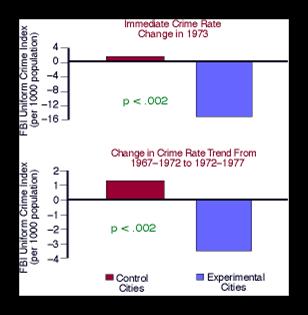
Figure 1: Twenty-four cities in which 1% of the population began Maharishi’s Transcendental Meditation program by 1972 displayed significant decreases in crime rate during the next year (1973) and a decreased crime rate trend during the subsequent five years (1972-1977 in comparison to 1967-1972). In contrast, crime rate increased in 24 matched control cities.
Methodological considerations : A strength of this and most of the subsequent research on sociological variables is that the data are public and available to everyone. Also, the FBI Uniform Crime Reporting system has standardized the definitions of the categories of crimes nationwide. A source of error is that only about half of crimes committed are ever reported. However, it can be assumed that this source of error is randomly distributed throughout experimental and control cities. Another problem is that many changes in the reporting procedures, such as computerization, affect the data. Because this study took place in a period when cities of this size were increasingly complying with FBI standards for reporting to the Uniform Crime Report index, a second analysis was conducted on a reduced sample of 20 1% and 20 control cities, which eliminated all cities which showed a sudden increase in crime that might have been an artifact due to a change in police reporting procedures. The results for this reduced sample were similar to the whole sample; a 22% decrease in crime in 1% cities in 1973 compared to an increase by 2% in control cities (p<.005), and a reduction in crime rate trend in the 1% cities by 89% compared to an increase of 53% in control cities (p<.05). In addition, a significant correlation was found between percentage of TM participation in each city in 1972 and crime rate change in 1973 (r=-.53, p<.001) and change in slope (r=-.41, p<.01).
With regard to the independent variable, the number of people learning the TM technique in the cities was collected by the TM organization independently of the hypothesis of the experiment or knowledge of crime rates in the cities. Local records were updated when people moved.
The main methodological issue is whether a third possible variable may have caused both increased TM numbers and decreased crime. The study attempted to address this problem by statistically taking into account the effects of the major demographic variables known to be correlated with crime rates. Stepwise discriminant analysis showed that 1% cities and control cities were similar on per capita income, percentage of persons aged 15 to 29, stability of residence, percentage unemployed, and percentage of families with incomes below poverty level, all known to be correlates of crime. Analysis of covariance was used to control for the effects of two crime-related variables on which the two groups of cities did differ, median years education and pre-intervention crime rate slope.
However, a causal interpretation would certainly be strengthened by a randomized experiment. Randomization in this case would mean either randomizing which cities had meditators and which cities did not, by pre-selecting cities and then teaching meditation only in randomly selected experimental cities, or by taking all the 1% cities and having the people in randomly selected experimental cities meditate and then having the controls not meditate for a year. It would be very expensive to teach 1% in several cities, but not impossible. With regard to the second suggestion, given that the practice has wide ranging benefits, it would be unethical to ask people not to meditate. In any event, to our knowledge there has never been a true randomized study on this scale in the history of the social sciences. 22 In the context of current events, we could randomly assign cities at risk for terrorist attacks, stratified for degree of risk, and assign them to experimental and control groups and see whether TM participation reduces the incidence of risk of terrorism over a five-year period. But as we shall see, the more powerful TM-Sidhi technique would be easier to implement in such an experiment.
2) Crime in 160 US Cities—A Causal Analysis: 1972-1978.
To strengthen a causal interpretation using archival crime data, Dillbeck and colleagues conducted causal analyses on large random samples of 160 cities and 40 standard metropolitan areas over a fifteen year period. 23 Causality implies lagged-correlation, i.e., the cause should precede the effect in time. 24 One type of causal analysis, called cross-lagged panel correlation, compares the synchronous correlation (the correlation between two variables at the same time) with the lagged correlations (the correlation of a variable with another variable at earlier and later times). The hypothesis that A is causing B is supported if variations in A are followed in time by correlated changes in B, whereas changes in B are not followed in time by correlated changes in A, assuming that the synchronous correlations at both time periods are equal. 25
Crime data is only readily available for cities on a yearly basis, so only relatively slowly evolving processes can be studied using this data. However, yearly data should be expected to capture the dynamics of the prediction that rising numbers of TM participants would cause a decline in crime rate in subsequent years. This prediction was tested in a stratified random sample of 160 US cities, which was comprised of 40 cities in each of 4 population groups—greater than 250,000; 100,000 to 250,000; 50,000 to 100,000; and 25,000 to 50,000. This sample comprised 25% of the total urban population of the United States (1970 census). The study was from 1964 to 1978. As before, FBI total index crime data were used.
For each city, a trend line was calculated that represented changes in crime rate from 1964 to 1971, before significantly large numbers began practicing the TM program in the United States . The trend line was projected from 1972 to 1978 to predict what the crime rate might have been had the earlier trend continued. The trend of increasing crime seen from 1964 to 1971 was predicted to continue in the period from 1972 to 1978 in cities with low percentages of TM participants. However, in the cities with high percentages of TM participation, the slope of the crime-rate trends were predicted to decline below the previous slopes. The assumption of stationarity was tested and upheld.
All but one of the crossed-lagged differences were in the direction that would be predicted by the hypothesis of TM program causality (p‘s ranged from <.01 to .05).
Methodological considerations: Was the effect due to a third unknown variable? Partial correlations were used to control ten specific social variables known to influence crime—median years education, percent unemployed, per capita income, percent of families in poverty, stability of residency over five years, median age, percent over age 65, population size, population density, and ratio of police per population. However, the possibility of a third causal variable, however remote it may seem, can not be completely ruled out without true randomization.
Because some of the smaller cities in the random sample could have been part of a larger metropolitan area, a second cross-lagged panel analysis was conducted using Standard Metropolitan Statistical Areas (SMSA).
3) 80 US Standard Metropolitan Statistical Areas (SMSAs)—A Second Causal Analysis: 1972-1979.
Using the same causal analysis as above for the 16 year period from 1964 to 1979, a second study was conducted on a random sample of 80 SMSAs constituting 55% of the SMSAs with over 200,000 population. This sample included 47% of the total metropolitan population of the United States. The results were essentially the same as with the other cities studied; a stable causal structure was found that supported the hypothesis that the TM practice in a population reduces crime rate. Both raw correlations and partial correlations, which controlled for other variables known to influence crime, showed that level of TM participation predicted reduced crime in subsequent years (p < .01 for each year). The magnitude of the correlations of TM leading crime decrease were small, an average of -.22, accounting for 5% of the total variance. However, a correlation of this magnitude is equivalent to an improvement of 17.6% in a dichotomous outcome variable (e.g., cure rate) due to a treatment26 (see Figure 2).

Figure 2: This figure shows an example of the correlation structure between percent TM participation in a city and crime change. In this case, the results are for 80 Standard Statistical Metropolitan Areas for 1973 predicting 1979. It can be seen that the level of TM program participation in 1973 significantly predicted decreased crime rate in 1979 (-.257). On the other hand, the crime rate in 1973 did not significantly predict TM participation in 1979 (-.033). A similar causal structure was for other comparisons, 1973 with 1974, 1973 with 1975, etc.
4) Intersubject EEG Coherence: 1979.
This was the first of a series of studies that attempted to look at possible physiological mediating variables of the Maharishi Effect. The general rationale for these studies is that if the Maharishi Effect were influencing behavior, it must also have an effect on the physiology. We elected to study the Yogic Flying technique because it is practiced in a group at specific times, thus providing a discrete time frame for looking for effects, and an exact count of the number of people participating, as compared to the crime studies of many people scattered throughout the population practicing the TM technique on different schedules and with varying degrees of regularity. 27 We studied EEG coherence because previous research found that a Yogic Flyer’s EEG coherence maximizes immediately prior to lift off. 28 (It is difficult to tell what happens during Yogic Flying because of movement artifacts.)
The possible relevance to crime and other violent behavior is that high EEG coherence increases during the TM technique, 29-31 especially during periods of transcendental consciousness, 32-34 35 and is positively correlated with principled moral reasoning, intelligence, and creativity. 28 36-42 These correlations range from .3 to .7, indicating that coherence is only an imperfect measure of overall integration. In this experiment we studied changes in EEG coherence between subjects during Yogic Flying practice of a large group at a distance.
The study was conducted in 1979 when a group of 2500 individuals was assembled in <st1:placew:st=”on”> Amherst , Massachusetts , to practice the TM and TM-Sidhi programs to create coherence in collective consciousness in order to prevent a possible nuclear war at that time. At Maharishi University of Management (MUM), 1170 miles away to the southwest, we measured the EEG coherence between three subjects placed in different sound-attenuated rooms during the precise time of Yogic Flying sessions at Amherst on six experimental days and on six control days after the Amherst course had terminated. The EEG subjects practiced the TM program through the EEG session. The rationale for this was that meditation is a ”low noise” state that might have a better chance of detecting an effect. The hypothesis was that during Yogic Flying EEG coherence would increase between subjects. The three subjects and lab technicians were blind to the purpose of the experiment.
Intersubject EEG coherence was measured between frontal (F3 and F4) and central leads (C3 and C4) because the frontal regions of the brain are where EEG changes occur during TM practice. That is, coherence was measured between F3 of subject 1 and F3 of subject 2, between F3 of subject 1 and F3 of subject 3, and between F3 between of subject 2 and F3 of subject 3. The average of the three coherences between subjects was the data used. In a similar manner, coherence between subjects was measured for F4, C3, and C4 EEG leads.
Intersubject EEG coherence was generally low, between .35 and .4, compared to coherence values on the order of .8 within subjects’ brains using similar measurement parameters. However, coherence is analogous to correlation squared. It gives the amount of variance in one EEG lead that can be linearly predicted from knowledge of the activity in the other lead. A coherence level of .4 means that 40% of the variance in one lead could be predicted by the other, equivalent to a correlation of .63, which is not trivial. It means that 40% of the activity in one person’s brain can be predicted by another person’s brain. This may be due simply to the fact that different people’s EEGs are quite similar in spectral characteristics. Most people show an alpha wave, for example. Interestingly, on both experimental and control days, intersubject EEG coherence in the alpha (8.2—11.95 Hz) and beta 2 (15.7—19.92 Hz, a harmonic of alpha) range was five standard errors of the mean higher than coherence in the delta (1.17-4.45 Hz) or beta 1 (11.95—15.7 Hz) frequencies. Perhaps this means that people are more similar in alpha than in delta.
Analysis of variance showed that during the Yogic Flying at Amherst , coherence across all frequencies increased statistically significantly (about 2 standard errors of the mean) on experimental days during the 15 minute Yogic Flying period compared to the 15 minute baseline periods on the same day. Figure 3 shows the mean change scores from the 15 minute baseline period to the 15 minute experimental period, averaged over the six experimental days and six control days. The data are shown in percent coherence, which ranges from 0 to 100%. It can be seen in the figure that the greatest change was in the alpha frequency. Alpha averaged across the four derivations (F3, F4, C3, C4) increased .64% during the experimental days but showed virtually no change on control days.
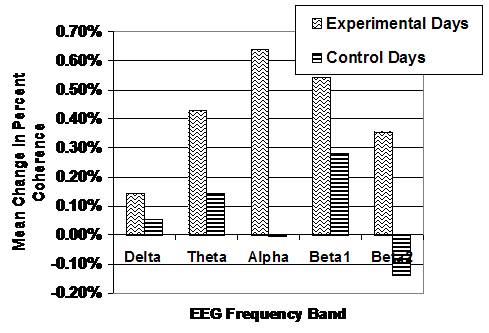
Figure 3: This figure shows the mean change in coherence from the 15 minute baseline to the 15 minute experimental period between three subjects in three different rooms in the EEG laboratory in Fairfield , Iowa . The values shown are for each EEG frequency band averaged across all EEG derivations (F3, F4, C3, C4). Coherence between the Fairfield subjects increased significantly (p < .02, multivariate test of all frequencies) during the experimental period on experimental days when 2,500 people were practicing Yogic Flying over 1,000 miles away in Amherst, Massachusetts, compared to the same time of day (dummy experimental period) when there was no Yogic Flying. The biggest change was in the alpha frequency.
One argument that the increased EEG coherence between people was not just an artifact due to everyone having a relatively strong alpha generator in their brains is that alpha power across derivations actually decreased significantly (p = .001) during the experimental period relative to baseline on experimental days compared to control days during those periods.
Table 1 shows change in coherence averaged across subjects and experimental and control days for each frequency and derivation. The greatest change (.91%) was for left frontal alpha. Also, it appears that the change in the frontal was greater that in the central. Table 2 shows the mean alpha change in the two frontal derivations was greater than the mean of the two central derivations. The mean in alpha coherence between the two frontal derivations (.82%) was approximately twice the change in central alpha (.46%).
TABLE 1:
Mean Change in EEG Coherence *
Between The Three subjects on the Six Experimental
Days and the Six Control Days.
|
EEG Freq. Band |
Experimental Days |
Control Days |
||||||||
|
|
F3 |
F4 |
C3 |
C4 |
Mean E |
F3 |
F4 |
C3 |
C4 |
Mean C |
Delta |
0.13% |
0.55% |
-0.03% |
-0.07% |
0.15% |
0.07% |
-0.17% |
0.10% |
0.21% |
0.05% |
|
Theta |
0.15% |
0.73% |
0.30% |
0.54% |
0.43% |
0.50% |
0.05% |
-0.09% |
0.12% |
0.15% |
|
Alpha |
0.91% |
0.73% |
0.31% |
0.61% |
0.64% |
0.16% |
0.12% |
0.05% |
-0.35% |
-0.01% |
|
Beta1 |
0.62% |
0.30% |
0.65% |
0.60% |
0.54% |
0.58% |
0.41% |
0.04% |
0.10% |
0.28% |
|
Beta2 |
0.50% |
0.40% |
-0.03% |
0.55% |
0.36% |
-0.11% |
0.03% |
-0.30% |
-0.18% |
-0.14% |
* Coherence is here expressed as percent coherence, which ranges from 0 to 100%.
A .9% increase indicates that the variance in the EEG of one subject increases
the ability to predict the variance in another subject’s EEG by .9%.
TABLE 2:
Mean Change in EEG Coherence between Subjects
On Experimental and Control Days for Frontal
and Central Derivations
|
|
Frontal (F3, F4) |
|
Central (C3, C4) |
|
|
Frequency |
Experimental |
Control |
Experimental |
Control |
Delta |
0.34% |
-0.05% |
-0.05% |
0.16% |
|
Theta |
0.44% |
0.28% |
0.42% |
0.02% |
|
Alpha |
0.82% |
0.14% |
0.46% |
-0.15% |
|
Beta1 |
0.46% |
0.50% |
0.63% |
0.07% |
|
Beta2 |
0.45% |
-0.04% |
0.26% |
-0.24% |
The 15 minute experimental period of Yogic Flying by the group in Amherst always occurred at the same time of day period (3:55—4:10 PM CST). To control for how long the subjects were in the EEG lab before the experimental period occurred, the one-hour EEG session was started at different times on different days, so that the experimental period began at different times relative to the start of the session. This controlled for changes over the duration of the experimental session, such as a fatigue effects.
Since the control days were all after the experimental days, we looked to see if there was a progressive decrease in change in coherence over the six experimental days that might account for the lesser change during the control days. Day to day results did not show any evidence of progressive changes in coherence that could account for the results.
Methodological considerations: As noted earlier, one possible confound is that three separate oscillators may be spuriously correlated simply because they are of similar spectral composition, not because they are directly interacting. However, this does not appear to explain why coherence increased on experimental days, and specifically in frontal alpha. Alpha is not as common in frontal brain areas as it is in occipital areas. Frontal alpha is where the EEG changes most during the TM technique, centered around 8 Hz. In contrast, occipital alpha does not change much during TM practice, and it tends to be around 10 Hz. 20 43 Mathematically, increased coherence means increased stability of the phase angle of the EEGs being compared. That is, the brain waves being compared have become more similar in frequency, or they have become more similar in how they change in frequency —coherence measures both. On a purely descriptive level, then, the brain waves of the three EEG subjects became more in phase during the experimental period. And they became more in phase in the frequency band (alpha) that is associated with restful alertness, the state of “Yoga”, Maharishi’s transcendental consciousness. Moreover, they became more in phase in the highest executive association area of the brain (frontal).
We would like to think that increased intersubject EEG coherence has something to do with increased harmony between people reflected in the sociological experiments. Were the subjects becoming more in tune with the unified field of natural law? Is there some preferred EEG frequency that we settle into when we come in tune with the integrative basis of natural law? Our interpretation of this data is that we were able to demonstrate the effects of the unmanifest unified level of natural law on the manifest level of human physiology. In this view, the common factor that influenced the brain functioning of the different test subjects was the unified field, the infinite organizing power of natural law that alone is capable of organizing all the different tendencies in society in a mutually supportive way. However, we are not aware of any other studies of intersubject EEG coherence. Such information might make its behavioral implications easier to interpret.
As always, randomization of the independent variable would have been ideal, but was not practically feasible. Other researchers have independently been studying EEG and evoked potential coherences between subjects, and like the present study, have found small but statistically significant effects.44-46
5) Transfer Function of Intrasubject EEG Coherence:1987.
This second experiment on field effects using EEG coherence studied the relationship of the EEG coherence within the brain of a single Yogic Flier in one room in the laboratory at MUM and EEG coherence of non-meditating test subjects performing a computer task in another room. 47 A pilot study had shown that Yogic Flying by a single subject improved the performance of acquisition of concepts in a concept-learning task in another subject in another building. In this study the computer task was well learned and the study focused on EEG effects.
There were ten test sessions total, with five non-meditator test subjects, each tested one at a time on two sessions. The subjects were blind to the purpose of the experiment. The same Yogic Flier was used in all sessions. He may have guessed the general purpose of the experiment, because he was prepped first and could have heard the other subject come in, but he was blind to the experimental design.
Time series transfer function analysis showed that in six of the ten sessions, increases in the coherence of the Yogic Flyer led increases in EEG coherence in the test subject in another room but not vice versa. The effects were stronger for sessions in which the Yogic Flier had subjectively deeper experiences.
Methodological issues: Time series analysis provides a powerful means of studying the relationship between two processes, but there are some technical issues to keep in mind. In a transfer function analysis, the two data series being compared are modeled (pre whitened) to remove any time correlated structure within each series. Time dependencies include cycles (autocorrelated components), drifts (integrated components) and periodic spikes in the data (moving average components). Once the residuals of the modeled series are random (indicating that all time-correlated structure has been successfully removed), the correlation structure between the two series is studied at different lags. If one series is hypothesized to be causal to another, then the correlation structure should show that changes in the causal series would lead by some reasonable amount of time changes in dependent variable. The logic is similar to cross-lagged panel analysis discussed previously. Because the data is pre whitened, any cross correlation between the two series cannot be attributed to artifacts arising from the time dependencies within the individual data sets. This is conservative because the causal variable may in fact have a periodic influence on the dependent variable, which would be removed by the prewhitening process and not seen in the resulting transfer function model.
An issue in modeling and causal interpretation is that it is often the case that there are different possible models choices in the prewhitening process that give adequate residuals which are free of auto-correlation structure. And with long data series, many statistically significant autocorrelations may arise by chance and it may be difficult to model all of them adequately. The caution is that different models may give different outcomes in the transfer functions and cross correlations. To provide an objective choice of which model to use, this study employed the Akaike Information Criterion (AIC). 48 The model used was the one with the smallest AIC, which is the one that gives the most predictive power with the least number of parameters.49 The AIC was used in all our studies employing time series analysis.
One possible confound in these field-effect studies of single subjects is to control for the effects of large groups meditating together at that same time that might create an influence that would obscure the results of individual meditators. At MUM in Fairfield, Iowa at that time of the study, there were between 1500 and 2000 people meditating together in the AM and PM. To prevent the group effect from obscuring or contaminating the single-subject effect, tests were performed during the early afternoon when there was no group meditation or Yogic Flying going on at the university.
An interesting finding is that the leading relationship of the Yogic Flier’s EEG to the test subjects’ was maintained even in cases in which the test subject had numerically higher coherence values. This suggests that EEG coherence is a relative measure, not an absolute one. A number of different studies indicate that increased coherence within a subject indicates greater wakeful integration. But other studies show that higher coherence in one subject compared to another does not necessarily mean that the higher subject is more integrated. It may seem contradictory that EEG coherence is positively correlated with moral reasoning, intelligence, and creativity, but these correlations are low, in the .4 to .7 range, accounting for only 20% to 50% of the variance. That means that there are many subjects with high coherence who do not score high on tests of moral reasoning, etc., and vice versa. Our best guess is that EEG coherence does respond to some deeper underlying processes, such as during the experience of transcendental consciousness, but that it is only an imperfect reflection of what is going on. Perhaps functional neuroimaging will elucidate the situation.
Another issue in action-at-a-distance studies in which the subjects are near each other is to rule out other classical sensory means of communication, i.e., “sensory leaks”. Many studies in the literature have done this very well. In this study, the subjects were in sound-attenuated rooms, but the test subject might have conceivably heard the Yogic Flier thump as he landed. However, S’s did not report hearing anything. Moreover, if the test S oriented to the sound, orienting would have produced low frequency desynchronized low coherence EEG, not increased coherence.
Finally, the finding that the effect was strongest when the subject subjectively felt that the effect was strongest is similar to what other studies of field effects have reported in quite different contexts. This suggests that, as a general rule, subjective experience should not be ignored, but should be measured and studied.
6) Biochemical Stress Markers of Field Effects of Consciousness: 1990. Randomized and cross-sectional experiments on individuals have found that TM practice decreases cortisol excretion and increases serotonin, a biochemical pattern that has been associated with decreased aggression and hostility. 50 Dynamic regression analysis of time series observations over the 73-day experimental period found that day-to-day changes in the size of a TM-Sidhi group (mean 1400 people) was a significant predictor of immediate mean (natural log) overnight excretions of cortisol (a stress-related hormone) and 5-HIAA (main metabolite of the neurotransmitter serotonin), as well as the ratio of the excretion rates for 5-HIAA and cortisol, in 6 non-meditators living and working up to 20 miles from the group. The study supports the hypothesis that group practice of the TM and TM-Sidhi program reduces societal stress by producing beneficial neuroendocrine effects in non-meditators outside the group. These effects are similar to the neuroendocrine effects documented to occur in individuals who practice the TM program and could be due to the hypothesized field effect of group practice lowering the stress level in the surrounding population. 51
Methodological issues: Reverse causality was tested by using 5-HIAA and cortisol levels as the independent variable and group participation in the TM program as the dependent variable. No significant effect of reverse causality was found. Moreover, additional analyses that specifically modeled and removed the effects of weekends and daily temperature showed that weekend and temperature could not account for the effects. Direct behavioral interactions between the non-meditators and meditators in the community were not a plausible explanation of the effects because they reported limited interaction. Randomization of the TM group size would have allowed stronger inference of causality, but was not practical under the conditions of this quasi-experiment.
Although these physiological studies were interesting, as researchers we preferred to evaluate the effects of large groups of TM and TM-Sidhi practice on a global scale, always with the hope that this research would demonstrate practical means of reducing conflicts in society and between nations.
7) Washington , DC —Decreased Violent Crime: 1993.
This study was a prospective experiment in which a group of approximately 4,000 participants in the Transcendental Meditation and TM-Sidhi programs assembled in Washington , DC , from June 7 to July 30, 1993. The District of Columbia Metropolitan Police Department (DCMPD) provided weekly crime data from a database used for their FBI Uniform Crime Reports. The study statistically controlled for the effects of weather variables, daylight, historical crime trends and annual patterns in the District of Columbia , as well as trends in neighboring cities.
Time series analysis of 1993 data showed that homicides, rapes and assaults (HRA) crimes dropped significantly during the Demonstration Project, corresponding with increases in the size of the group. The maximum decrease was 23.3%, p < 2 x 10⁻⁹, (24.6% using a longer baseline, with 1988-1993 data, p < 3 x 10⁻⁵), coincident with the peak number of participants in the group during the final week of the assembly (see Figure 4). No significant decreases in HRA crimes were found during the same period in each of the five previous years. Nor could the effect of the coherence-creating group on reducing HRA crimes be accounted for by additional police staffing. The results for HRA crimes were highly robust to alternative time-series model specifications, and showed that the effect of the group size was cumulative and persisted after the Demonstration Project ended. Calculation of the steady-state gain based on the time-series model predicted that a permanent group of 4,000 coherence-creating experts in the District would have a long-term effect of reducing HRA crimes by 48%. 52
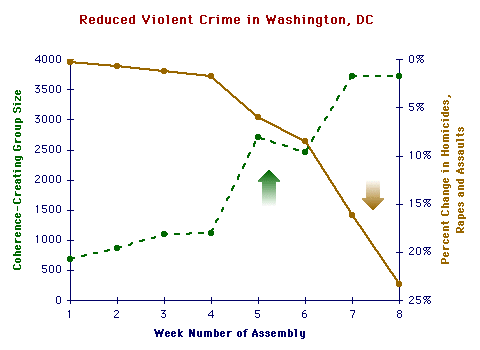
Figure 4: This figure shows the drop in violent crime in Washington DC (solid line) as the size of the coherence group of TM and TM-Sidhi participants increased (dotted line).
It should also be noted that another major purpose of the project, which was lodged in advance, was to create coherence for the government. During the project, a floundering Clinton administration suddenly began to make progress. On July 18th, journalist Sally Quinn wrote in the Washington Post : “Well, in case anyone hasn’t noticed, Washington is in a lull, at least from the vantage point of the inmates…. the Clinton administration appears to have revived….But such a swift reversal of political fortune is not easy to account for. The inmates may logically wonder whether Clinton really turned things around or if something else is going on…almost mysteriously and almost overnight, in the face of government distress…” (p. C1). 53
This change was also observed from inside the White House. Clinton ‘s special assistant and White House press secretary, George Staphanopoulos, wrote of that period that by the Fall of 1993, the Clinton White House had found its footing. It held the Middle East peace ceremony, passed NAFTA and the Brady bill, got its economic plan through and had proposed the centerpiece of its domestic agenda: Health-care reform. 54 Coincident with the onset of the Demonstration Project Clinton’s approval rating increased (p = 5.29 X 10⁻⁸) , media positivity increased towards the president (p = .01) and all five available indicators of social stress in the District decreased: emergency psychiatric calls (p = .009), hospital trauma cases (p = .02), complaints against the police, (p = .01), accidental deaths (p = .05), and a social stress index of the four (p = 3.22 X 10⁻⁵). 55 56
Methodological issues: An important issue in intervention studies of this kind that claim to produce broad positive sociological change is to lodge the predictions in advance with outside scientists and policy makers. The hypothesis that levels of violent crime in the District of Columbia would fall substantially and harmony in government would increased during the Demonstration Project was posited with a 27-member Project Review Board comprised of independent scientists and leading citizens. The Board approved the research protocol and monitored the research process.
The following studies are presented last because they take our discussion of field effects from the individual and urban levels to whole nations, international conflicts, and terrorism.
8) Israel —Decreased Crime and Improved Quality of Life in Jerusalem and Israel as a Whole and Decreased War Intensity in Lebanon : 1983.
This project was a critical experimental demonstration of the Maharishi Effect on armed conflict in a major trouble-spot area: the civil war in Lebanon . The experiment created a group of resident Israeli TM and TM-Sidhi experts in Jerusalem at an arbitrarily picked time (July and August 1983) to test the effect of the group on crime and the quality of life in Jerusalem and Israel as a whole, and on the war in neighboring Lebanon . The major hypotheses and the proposed categories of measurements were lodged in advance of the experiment with a group of research scientists in the U.S. and Israel . Upon arrival in Israel , the authors met with Israeli scientists to finalize selection of a smaller subset of measures.
The analysis of the results used all of the non-redundant daily time-series data available at the time of departure of the researchers from Israel in the fall of 1983; these included eight social indicators: (1) crime in Jerusalem, (2) crime in Israel as a whole, (3) automobile accidents involving personal injury in Jerusalem, (4) fires in Jerusalem, (5) a stock index of all freely traded stocks on the Tel Aviv stock exchange, (6) a national-mood scale derived from content analysis of a major newspaper, (7) reported war deaths of all factions in the Lebanese war, and (8) a war-intensity scale of the Lebanese war derived by newspaper content analysis.
The critical thresholds of TM and TM-Sidhi participants needed for Jerusalem , Israel , and Lebanon were calculated at 65, 122, and 197, respectively, which took into account the number of meditators already in the area. The size of the experimental group actually fluctuated between 65 and 241, due to the varying degrees of ability of individuals to leave their jobs and families to participate in the study.
Time series transfer function analysis of daily data indicated that crime decreased by 7.4% in Jerusalem (p = .023) and by 4.1% in Israel as a whole (p = .022). When the group was largest, the war in Lebanon was impacted, as seen by decreased war deaths (by 75.9%, p = .019) and war intensity (p = .0045). 57
In the study in Israel, the effects were generally stronger for composite quality of life indices than for individual measures. The Overall composite index of all variables showed an increase of 1.69 standard deviations. The stronger results for the indices than for the individual variables suggests the presence of a common influence of coherence acting on all the variables at once. This was most clearly seen when the common variance was enhanced and random components were canceled through signal averaging. This result supports the hypothesis that the TM and TM-Sidhi techniques operate to create coherence on a fundamental, unifying level of natural law (see Figure 5).

Figure 5: The Overall Composite Quality of Life Index, composed of war intensity in Lebanon , crimes, fires, national mood, automobile accidents, and the stock market in Israel , adjusted so that a positive deflection indicates improved quality of life, closely tracked the size of the coherence creating group of TM and TM-Sidhi participants located in Jerusalem.
Methodological issues: A secondary analysis of the data indicated that decreased war in Lebanon was a robust finding, statistically significant for 14 different specifications of the noise model. In fact, using the objective AIC criteria of best noise model choice (the model that gave the most predictive power with the least number of parameters), the best model gave the strongest intervention effect. 22 This indicates that the result was not a spurious artifact of autocorrelation.
Perhaps the single most important issue in studies that make unusual claims is replication. This result of decreased war in Lebanon due to groups practicing the TM and TM-Sidhi program has been replicated seven times using a daily data base constructed from many media sources representing all factions in the war by an expert in the war who was blind to the experimental hypothesis. 58 In addition, the general principle of the Maharishi Effect has been replicated 50 times, 14 59 and is supported in principle by completely independent researchers, who find evidence of action-at-a-distance in a variety of different paradigms.
9) Decreased International Terrorism: 1983-1985. Terrorism is crime committed for political purposes, often on the international level. This study was observed the impact of three large assemblies approaching √1% of the world population for the world (n = 7000). The dependent variable was casualties and injuries due to international terrorism obtained from the Rand Corporation data bank for 1983-1985, aggregated into five-day periods. Using time-series intervention analysis to estimate the combined effects of the assemblies, the study found a significant reduction by 72% in worldwide terrorism after the beginning of the assemblies (p < .025). 60 The study also found significant decreases in international conflicts during the assemblies, as indicated by content analysis of major newspapers. Other research using independent data bases has also found significant reductions in international conflicts by large groups of TM and TM-Sidhi participants. 56 61-63
Methodological issues: A statistical difficulty in studying terrorism is non-stationarity of the data. Many days or weeks may go by with no event, and then a momentous event kills thousands, creating a data series that violates the assumption of normality. In the present study we found that aggregating the data into five-day periods smoothed it out and also eliminated any possible 7-day weekly cycles that might be in the daily series.
Where we stand now. With respect to this research, we have always taken the stance of defenders of Type II error, cautioning not to dismiss a phenomenon that may be beneficial to society just because it is difficult to explain by the current dogma of science. Others, including editors, peer reviewers, conference organizers, national review committees, have most often taken the stance of defenders of Type I errors, cautioning against admitting this evidence into the body of science. 64 In the early days their first line of defense was to simply ignore this research. Often it was summarily denied publication, on such grounds as “not being appropriate for this journal” or “supporting hypothesis outside the realm of normal science”. And in science, if something is not published, it does not exist. No one has to take it into account. As times changed, and as our research became more compelling, and as new journals arose that reflected rising world consciousness, some papers finally got published. Some fought vigorously to make this phenomenon disappear, and when criticisms were met and it didn’t disappear, they went back to simply ignoring it. 64 65
On September 11 we had a wakeup call. It is time we give this research the objective consideration that it deserves and that the world desperately needs. A group of scientists is going to our government with a proposal for trying this technology to reduce and prevent terrorism. Just as Einstein went to Roosevelt with a group of scientists to encourage development of an atomic technology, Dr. John Hagelin, a leading quantum physicist and Director of the Institute of Science, Technology, and Public Policy, Dr. Peter Salk, vice president of the Jonas Salk Foundation, Dr. David Edwards, professor of government at the University of Texas, and other concerned scientists have been meeting with members of Congress and the Cabinet about implementing this new defense technology. 66
Since terrorism is a worldwide phenomenon arising from ancient personal, ethnic, and political stresses throughout the world, rooting it out has to be carried out on a global scale. Maharishi’s urgent proposal is to form a group of 40,000 Vedic pundits in India as peace-keeping professionals. They would practice the TM and TM-Sidhi programs as well as other Vedic peace-generating technologies all day every day. Evaluation of the effects of this group would use independent data sources of terrorism (such as the Rand corporation data bank), intelligence from various governmental agencies, economic indicators, etc. to see if the group of 40,000 produces a significant improvement that could not have been predicted from the previous history of the various series under study (see www.permanentpeace.com). [Editor’s update: see also The Global Union of Scientists for Peace. GUSP is an emerging force in the prevention of terrorism, war, and social violence through the application of cutting-edge, field-tested solutions in the areas of conflict resolution, national security, and global peace.]
I ask you join us in this. We are faced with the prospect of an endless chain of destruction, back and forth. Political negotiations don’t work. Since the United Nations was formed in 1945 there have been 145 major wars. Since 1000 BC, there have been 8,000 peace treaties, which have lasted on an average of no more than nine years. Let is try something new. “Only a new seed will yield a new crop.” What greater research project could there be than to try to create world peace.
References
1. Hagelin JS. Is consciousness the unified field? A field theorist’s perspective. Modern Science and Vedic Science 1987;1(1):29–87.
2. Maharishi Mahesh Yogi. The Science of Being and the Art of Living. New York: New American Library Inc., 1963.
3. Maharishi Mahesh Yogi. On The Bhagavad-Gita A New Translation And Commentary: Chapters 1-6. Baltimore: Penguin Books Inc., 1967.
4. Maharishi Mahesh Yogi. Vedic Knowledge for Everyone. Vlodrop, Netherlands: Maharishi Vedic University Press, 1994.
5. Maharishi Mahesh Yogi. Maharishi forum of natural law for doctors. Vlodrop, The Netherlands: Maharishi Vedic University, 1996.
6. Hagelin J. Restructuring Physics From its Foundation in Light of Maharishi’s Vedic Science. Modern Science and Vedic Science 1989;3(1):3-72.
7. Nader T. Human Physiology-Expression of Veda and the Vedic Literature. Vlodrop, Holland: Maharishi University Press, 1995.
8. Nader T. Scientific research on the instant relief program. Available from: URL: http://www.vedic-health.com/healing/index.html 1997.
9. Nader T, Rothenberg S, Averbach R, Charles B, Fields JZ, Schneider RH. Improvements in chronic diseases with a comprehensive natural medicine approach: A review and case series. Behavioral Medicine 2000;26:34-46.
10. Patanjali. Yoga Sutras. New Delhi: Oriental Books Reprint Service, 1912/1978.
11. Orme-Johnson DW. Falling awake. The Archives of Scientists’ Transcendent Experiences (TASTE) 2000; online journal: www.issc-taste.org:Submission #00048.
12. Maharishi Mahesh Yogi. Creating an ideal society. Rheinweiler, Germany: MERU Press, 1977.
13. Orme-Johnson DW. Transcendental Meditation as an epidemiological approach to drug and alcohol abuse: Theory, research, and financial impact evaluation. In: O’Connell DF, Alexander CN, editors. Self Recovery: Treating addictions using Transcendental Meditation and Maharishi Ayur Veda. New York: The Haworth Press, Inc., 1994.
14. Orme-Johnson DW. Preventing crime though the Maharishi Effect. Journal of Offender Rehabilitation in press.
15. Borland C, Landrith III G. Improved quality of city life through the Transcendental Meditation Program: Decreased crime rate. In: Orme-Johnson DW, Farrow JT, editors. Scientific research on the Transcendental Meditation program: Collected papers, Vol. 1. Rheinweiler, Germany: Maharishi European Research University Press, 1977:639-648.
16. Wallace RK, Orme-Johnson DW, Dillbeck MC, editors. Scientific Research on the Transcendental Meditation Program: Collected Papers, Vol. 5. Fairfield, Iowa: MIU Press, 1990.
17. Orme-Johnson DW, Farrow J, editors. Scientific Research on the Transcendental Meditation program: Collected Papers (Vol. 1). Rheinweiler, West Germany: MERU Press, 1977.
18. Chalmers RA, Clements G, Schenkluhn H, Weinless M, editors. Scientific research on Maharishi’s Transcendental Meditation and TM-Sidhi program: Collected papers, Vols. 2-4. Vlodrop, The Netherlands: Maharishi Vedic University Press, 1989.
19. Wallace KR. The Physiology of consciousness. Fairfield: Maharishi International University Press, 1993.
20. Wallace RK. The neurophysiology of enlightenment. Fairfield, IA: MIU Neuroscience Press, 1986.
21. Dillbeck MC, Landrith III G, Orme-Johnson DW. The Transcendental Meditation program and crime rate change in a sample of forty-eight cities. Journal of Crime and Justice 1981;4:25–45.
22. Orme-Johnson DW, Alexander CN, Davies JL. The effects of the Maharishi Technology of the Unified Field: Reply to a methodological critique. Journal of Conflict Resolution 1990;34:756–768.
23. Dillbeck MC, Banus CB, Polanzi C, Landrith III GS. Test of a field model of consciousness and social change: The Transcendental Meditation and TM-Sidhi program and decreased urban crime. The Journal of Mind and Behavior 1988;9(4):457–486.
24. McCleary R, Hay Jr. RA. Applied time series analysis for the social sciences. Beverly Hills: Sage, 1980.
25. Kenny DA. Correlation and Causality. New York: John Wiley & Sons, 1979.
26. Rosenthal R, Rubin DB. A simple, general purpose display of magnitude of experimental effect. Journal of Educational Psychology 1982;74:166-169.
27. Orme-Johnson DW, Dillbeck MC, Wallace RK, Landrith GS. Intersubject EEG coherence: Is consciousness a field? International Journal of Neuroscience 1982;16:203-209.
28. Travis FT, Orme-Johnson DW. EEG coherence and power during yogic flying. International Journal of Neuroscience 1990;54:1–12.
29. Levine P. The coherence spectral array (COSPAR) and its application to the study of spatial ordering in the EEG. Proceedings of the San Diego Biomedical Symposium 1976;15:237-247.
30. Dillbeck MC, Bronson EC. Short-term longitudinal effects of the Transcendental Meditation technique on EEG power and coherence. International Journal of Neuroscience 1981;14:147-151.
31. Travis F, Wallace RK. Autonomic and EEG patterns during eyes-closed rest and Transcendental Meditation (TM) practice: A basis for a neural model of TM practice. Consciousness and Cognition 1999;8:302-318.
32. Badawi K, Wallace RK, Orme-Johnson D, Rouzeré A-M. Electrophysiologic characteristics of respiratory suspension periods occurring during the practice of the Transcendental Meditation program. Psychosomatic Medicine 1984;46(3):267-276.
33. Travis F, Pearson C. Pure consciousness: Distinct phenomenological and physiological correlates of “consciousness itself“. International Journal of Neuroscience 1999;100:77-89.
34. Farrow J, Hebert J. Breath suspension during the Transcendental Meditation technique. Psychosomatic Medicine 1982;44(2):133-153.
35. Orme-Johnson DW. EEG coherence during transcendental consciousness. Electroencephalography and Clinical Neurophysiology 1977;43(4):E 487.
36. Gaylord (King) C, Orme-Johnson D, Travis F. The effects of the Transcendental Meditation technique and progressive muscle relaxation on EEG coherence, stress reactivity, and mental health in black adults. International Journal of Neuroscience 1989;46(1-2):77-86.
37. Dillbeck MC, Araas-Vesely S. Participation in the Transcendental Meditation program and frontal EEG coherence during concept learning. International Journal of Neuroscience 1986;29:45–55.
38. Nidich SI, Ryncarz RA, Abrams AI, Orme-Johnson DW, Wallace RK. Kohlbergian cosmic perspective responses, EEG coherence, and the Transcendental Meditation and TM-Sidhi program. Journal of Moral Education 1983;12(3):166–173.
39. Orme-Johnson DW, Haynes CT. EEG phase coherence, pure consciousness, creativity and TM-Sidhi experiences. International Journal of Neuroscience 1981;13:211-217.
40. Orme-Johnson DW, Wallace RK, Dillbeck MC, Alexander CN, Ball OE. Improved functional organization of the brain through the Maharishi Technology of the Unified Field as indicated by changes in EEG coherence and its cognitive correlates: A proposed model of higher states of consciousness. In: Chalmers RA, Clements G, Schenkluhn H, Weinless M, editors. Scientific research on Maharishi’s Transcendental Meditation and TM-Sidhi program: Collected papers, Vol. 4. Vlodrop, The Netherlands: Maharishi Vedic University Press, 1989:2245-2266.
41. Sheppard WD. Pretrial EEG coherence as a predictor of semantic processing effects in a lexical decision test. Dissertation Abstracts International 1988;49(9):B3610.
42. Wallace RK, Mills PJ, Orme-Johnson DW, Dillbeck MC, Jacobe E. The paired H reflex and its correlation with EEG coherence and academic performance in normal subjects practicing meditation. Society for Neuroscience Abstracts 1982;8(537).
43. Wallace RK. Physiological effects of Transcendental Meditation. Science 1970;167:1751–1754.
44. Baumann S. Overview: Neurophysiological measurements and induction of meditation and spiritual experiences. In: A.Chez R, editor. Bridging Worlds and Filling Gaps in the Science of Healing. Kona, Hawaii, 2001.
45. Standish L. Neural energy transfer between human subjects at a distance. In: Chez RA, editor. Bridging Worlds and Filling Gaps in the Science of Healing. Kona, Hawaii, 2001.
46. Wallach H. Transferred potentials: Fact or artifact? In: Chez RA, editor. Bridging Worlds and Filling Gaps in the Science of Healing. Kona, Hawaii, 2001.
47. Travis FT, Orme-Johnson DW. Field model of consciousness: EEG coherence changes as indicators of field effects. International Journal of Neuroscience 1989;49:203-211.
48. Akaike H. Information theory and an extension of the maximum likelihood principle. In: Petrov BA, Csaki F, editors. International Symposium on information theory. Budapest: Akademia Kiado, 1973:267-281.
49. Larimore WE, Mehra RK. The problem of overfitting data. Byte 1985;10:167–180.
50. Walton KG, Levitsky DK. Effects of the Transcendental Meditation program on neuroendocrine abnormalities associated with aggression and crime. Journal of Offender Rehabilitation in press.
51. Walton KG, Cavanaugh KL, Pugh ND. Effect of group practice of the Transcendental Meditation program on biochemical indicators of stress in non-meditators: Causal analysis of a field theory of consciousness. Journal of Social Behavior and Personality in press.
52. Hagelin JS, Rainforth MV, Orme-Johnson DW, Cavanaugh KL, Alexander CN, Shatkin SF, et al. Effects of group practice of the Transcendental Meditation program on preventing violent crime in Washington D.C.: Results of the National Demonstration Project, June-July, 1993. Social Indicators Research 1999; 47(2):153-201
53. Quinn S. To the couch, Mr. Clinton. The Washington Post 1993 July 18;C1.
54. Staphanopoulos G. All too human: A political education. New York: Little, Brown, and Company, Inc., 1999.
55. Goodman RS. The Maharishi Effect and government: Effects of a National Demonstration Project and a permanent group of Transcendental Meditation and TM-Sidhi program practitioners on success, public approval, and coherence in the Clinton, Reagan and Bush presidencies. (Doctoral dissertation, Maharishi University of Management, Fairfield, IA, U.S.A.). Dissertation Abstracts International 1997.
56. Goodman RS, Orme-Johnson DW, Rainforth MS, Goodman DH. Transforming political institutions through individual and collective consciousness: The Maharishi Effect and government. Annual Meeting of the American Political Science Association 1997;Washington, D.C.
57. Orme-Johnson D, Alexander C, Davies J, Chander H, Larimore W. International Peace Project: The Effects of the Maharishi Technology of the Unified Field. Journal of Conflict Resolution 1988;32(4):776-812.
58. Davies JL, Alexander CN. Alleviating political violence through reducing collective tension: Impact Assessment analysis of the Lebanon war. Journal of Social Behavior and Personality in press.
59. Orme-Johnson DW. Transcendental Meditation as an epidemiological approach to drug and alcohol abuse: Theory, research, and financial impact evaluation. Alcoholism Treatment Quarterly 1994;11:119-165.
60. Orme-Johnson DW, Dillbeck MC, Alexander CN, Chandler HM, Cranson RW. Effects of large assemblies of participants in the Transcendental Meditation and TM-Sidhi program on reducing international conflict and terrorism. Journal of Offender Rehabilitation in press.
61. Orme-Johnson DW, Dillbeck MC, Bousquet JG, Alexander CN. The World Peace Project of 1978: An experimental analysis of the application of the Maharishi Technology of the Unified Field in major world trouble spots: Increased harmony in international affairs. In: Chalmers RA, Clements G, Schenkluhn H, Weinless M, editors. Scientific research on Maharishi’s Transcendental Meditation and TM-Sidhi program: Collected papers, vol. 4. Vlodrop, The Netherlands: Maharishi Vedic University Press, 1989:2532-2548.
62. Gelderloos P, Frid MJ, Goddard PH, Xue X, Löliger SA. Creating world peace through the collective practice of the Maharishi Technology of the Unified Field: improved U.S.-Soviet relations. Social Science Perspectives Journal 1988; 2(4):80–94.
63. The dynamics of U.S.-Soviet relations, 1979-1986: Effects of reducing social stress through the Transcendental Meditation and TM-Sidhi program. American Psychological Association; 1990; Boston.
64. Orme-Johnson DW, Alexander CN, Hawkins MA. Critique of the National Research Council’s report on meditation. Journal of Social Behavior and Personality in press.
65. Brown C. Overcoming barriers to use of promising research among elite Middle East policy groups. Journal of Social Behavior and Personality in press.
66. Institute of Science TaPP. “Invincible defense” strategy welcomed on Capitol Hill. Fairfield, IA: www.istpp.org, 2001:1.
U.S. Peace Congress Proposal
A proposal to fund Invincible Defense Technology in the United States is set forward the by U.S. Peace Congress.
Article: Fighting Terrorism in India by Singh and Leffler, Indian Armed Forces
This article was published on 08 November 2002 by IndianArmedForces.com (the publication closed – July 2006). Also reprinted by India Defence Consultants. Italian translation.
Fighting Terrorism in India
By Maj. Gen. Kulwant Singh (Retd.) and Dr. David Leffler
Terrorism is not an easy problem to solve. India has been fighting terrorism for over half a century. Since independence in 1947, the eastern states have been under the spell of insurgents, abetted by foreign countries. The disputed region of Kashmir is a powder keg, threatening to explode into conventional and possibly nuclear war any day. A viable solution may lie in India’s past-ancient Vedic knowledge that was scientifically validated in the 20th century. Now, in the 21st century, India’s ancient method of preventive defense, a form of defense called “invincible,” promises to end terrorism and conflict and set an example for the rest of the world. Is India ready to revive its illustrious past?
India has fought four major wars over the problem of the disputed POK (Pakistan Occupied Kashmir). Pakistan is unlikely to be able to win a conventional war against India. For this reason, Pakistan has allegedly resorted to sending terrorists into Kashmir, calling them freedom fighters. This holds true throughout the world: one side’s terrorist is another side’s freedom fighter. Globally, the impact of terrorism has been increasing since al-Qaeda formed alliances with existing terrorist organizations. The rise of tensions and the looming threat of nuclear war between India and Pakistan has triggered a mass exodus of foreign nationals from India as well as Pakistan.
Like many other countries, India has fought terrorism through a dynamic approach, i.e., with weaponry and military personnel. Despite its long-term military experience fighting terrorists, India is still losing the war. Terrorists continue to increase in number. Adding to the fray of foreign-based terrorists, new organizations are emerging, like the Peoples War Group (PWG). The number of such organizations and cadres who have joined them is alarming. Even with fully equipped police and para-military forces, India will not be able to completely control them. Even more alarming, defence experts predict that it is just a matter of time before terrorists attack with weapons of mass destruction which may be handheld and easy to transport and conceal.
Tensions between India and Pakistan rise and fall, and frequently, both are poised for war. If war starts, India’s strategy, as announced so far, is for a “limited offensive” to stop terrorism. The term “limited offensive” itself is misleading, as it cannot be quantified. Does it imply limiting effort in the employment of forces, the areas of offensive, use of weapon systems and so on? In any case, India’s leaders may want it to be limited, but this cannot dictated to its opponents. In all probability, once war starts, it will not be limited.
Can India eliminate terrorism by deploying military forces, as it has for the last 50 years? Again and again, history shows that the answer is “no.” Terrorism is a human problem. Therefore, it requires a human solution. The underlying cause of terrorism, war, conflict as well as other types of social violence, is accumulated social stress.
If the collective social stress driving terrorism could be prevented, such negative problems would cease. Thus, no collective stress-no terrorism, and no war.
A silent approach to achieve this prevention ideal is described in the Vedic literature. Heyam duhkham anagatam (Yog-Sutra, 2.16): “Avert the danger before it arises.”
The Yog-Sutra, 2.35 also affirms Tat sannidhau vairatyagah: “In the vicinity of Yogic influence-unifying influence, integrating influence, coherent and harmonious influence-conflicting tendencies do not arise.” These ancient principles applied in the past, and they apply today.
According to Vedic tradition, conflict resulted from ignorance-ignorance of how to prevent the build-up of collective stress. For example, the Ramayana stated that “…ignorance will have no access within eight miles from [the Yogi’s hermitage].
“The Ramayana also described the ancient city of Ayodhya. “Ayodhya” means “the city none can challenge in warfare.” Certainly, Ayodhya relied on the conventional defence technologies of its time. For instance, “It was enclosed by strong fortifications and a deep moat, which no enemy, by any expedient whatsoever, could penetrate.” Also, “Ayodhya abounded in warriors undefeated in battle, fearless and skilled in the use of arms, resembling lions guarding their mountain caves.” However, the descriptions of the enlightened, stress-free life of the inhabitants of Ayodhya may indicate that its first line of defense was the city’s freedom from collective stress. According to the Ramayana, this low stress level, based on life in harmony with Natural Law, made Ayodhya worthy of its name.
Could this ideal of preventive defence again be accomplished in India? Vedic scholar and physicist Maharishi Mahesh Yogi revived the practical components of the silent approach of Invincible Defence Technology – he calls them the Transcendental Meditation (TM) and TM-Sidhi program. These human resource-based technologies need not require or involve religious belief and practices. These meditation techniques have been practiced by members of many faiths worldwide. Extensive scientific research documents the ability of the TM and TM-Sidhi program to dissolve stress on the individual and collective levels. India could use this nourishing and non-destructive Invincible Defence Technology to reduce tensions, thereby preventing conflicting tendencies that drive terrorism.
The operative part of Invincible Defence Technology requires having a Prevention Wing of the military. This wing would comprise about 2-3% of the armed forces. The rest of the military would carry on with their usual duties. The Prevention Wing of the military would create societal coherence by practicing the TM and TM-Sidhi program in large groups morning and evening. Their collective practice would produce positive benefits for both themselves and their adversaries. Peaceful overtures would increase from all sides.
Similar coherence-creating groups have been deployed in many war zones and conflict prone areas with great success. Extensive scientific research indicates that when 1% of the population (i.e., a city), or the square root of 1% of the population (i.e., a nation) practices the more advanced TM-Sidhi program in a group, a “field effect” is created.
This effect is called the “Maharishi Effect” by scientists. Over 50 carefully controlled studies have documented and validated positive social trends such as reduced conflict and lowered crime rate. These studies have been scrutinized and published in respected peer-reviewed journals such as Social Indicators Research, Journal of Conflict Resolution, the Journal of Mind and Behavior and Journal of Crime and Justice.
This coherence-creating effect has also been documented on a global scale. When large assemblies of practitioners of the TM-Sidhi program exceeded the Maharishi Effect threshold for the world (about 7,000 at that time) during the years 1983-1985, international conflict decreased 32%, terrorist casualties decreased 72% and violence was reduced in other nations without intrusion by other governments.
Thus, the deployment of a Prevention Wing of the Military by India could be a force multiplier. It strengthens both approaches of defence-the dynamic approach of weaponry and military personnel, and the silent approach of Invincible Defence Technology. India’s defence will be perfect, or invincible, when both these approaches are combined.
India cannot solve the problem of terrorism by standard military means alone. It also needs a silent approach, which will help people focus more on peaceful means of settling differences. India’s Vedic heritage offers the ideal means to fight terrorism and prevent war. India needs to deploy a Prevention Wing of the Military immediately for lasting peace.
Editor’s Note: Articles about Invincible Defence Technology, published in Defence India, Defense Review, India Defence Consultants, Indian Defence Review, Indian Strategic Review, The Modern Tribune, The Daily Excelsior, Defence Talk, Security and Political Risk Analysis Bulletin, The Seoul Times, Aljazeera Magazine, PakTribune, Congo Forum, Sri Lanka Guardian, Pakistan Daily, The Bottom Line, Arab News, Middle East Online, Hi Pakistan, Soldier of Africa, Frontier India Strategic & Defense, Sentinel Review, Congo Watch, Beirut-Online, India Defence Consultants, The Pakistani Spectator, Senegambia News, Fiji Daily Post, News From Bangladesh, Muslim, Intent, United News Network, News Wing, Muslim World Today, Sinhala, MEPeace, Southern Asian Outlook, Northern News Lines, Sudan Watch, Blitz, New Age Islam, The Earth Times, Newstrack India, Uganda Watch, The Morung Express, Chowk, and Islam And Muslims are available at: https://davidleffler.com/links-worldwide.
 |
Maj. Gen. (Dr.) Kulwant Singh, UYSM, Retd. received his Ph.D. and M.Sc. in Defence Studies from Chennai University. He also has a postgraduate diploma in Human Resource Development from Indira Gandhi National Open University (IGNOU) in New Delhi. Dr. Singh has a postgraduate diploma in Management from the Regional College of Management and Technology (RCMT). He qualified for the prestigious Higher Command Course at College of Combat and is a graduate of the Defence Service Staff Collage. He fought in combat and led India’s fight against India’s intransigent terrorism problem for nearly 30 years. Maj. Gen. Singh was awarded the Uttam Yudh Sewa Medal, the second highest decoration for senior officers during operations in Sri Lanka as part of IPKF (Indian Peace Keeping Force). Today he is leading an international group of generals and defense experts that advocates Invincible Defence Technology. Dr. Singh lives in New Delhi, India. |
 |
Dr. David Leffler received his Ph.D. on the topic of Invincible Defence Technology from Union Institute & University. His other academic degrees include: a B.A. in Education, an M.A. in the Science of Creative Intelligence from Maharishi University of Management and an M.M. in Education from New Mexico State University. He was a member of the U.S. Air Force for eight years. Dr. Leffler is the Executive Director at the Center for Advanced Military Science (CAMS) at Maharishi University of Management. He also serves as a Peer Member at The Union Institute and is a member of the U.S. Naval Institute. Dr. Leffler has given presentations on Invincible Defence Technology at the Russian Air Force Academy, the Russian Academy of Sciences, and defense-related institutions in the United States. |
© 2002 David R. Leffler and Kulwant Singh. All rights reserved.